
A reading from the balance, not a sticky note
Place the vessel — the weight lands in the sample record. Less retyping, fewer transcription errors that trigger CAPA, client complaints, or failed assessments.
Design of the WAPP LIMS desktop app with demo data from a drinking-water lab. The product is in development: pilot labs work with it first.
Everyone sees what is in progress, urgent, overdue or waiting for review. Filters by client, method and due date replace the paper log.
AI reads the sampling report from a photo and fills the fields; a person checks and confirms them.
Analysts enter a batch for one method in large fields. The LIMS calculates the result with uncertainty and flags a value above the limit before it is saved.
An instrument with expired calibration blocks saving, so an untraceable result never reaches the report.
The report is assembled from the records the system already holds. Before signing, the review lists what an assessor would flag: an expired calibration, a missing decision rule, a method outside the scope.
One report in German and English, exported to PDF or DOCX.
Calibration and maintenance dates for every instrument, with what expires this month. Expired equipment is blocked automatically.
Years of sample logs move in without manual retyping: AI recognises the columns, a person checks the mapping, and nothing is saved until the last step.
Place the vessel — the weight lands in the sample record. Less retyping, fewer transcription errors that trigger CAPA, client complaints, or failed assessments.
One screen — one action, large controls. Consumer-style web UX gets abandoned on a chem bench: if it is awkward, Excel wins again.
Immutable logs and record versions accumulate in the background. Analysts do chemistry — quality and assessors still get the evidence pack ISO/IEC 17025 expects.
Roles, reviews, and e-signatures in one flow. Managers do not collect scans from shared drives before releasing a result.
Screens and master data follow your methods and accreditation scope. The point is that an analyst can capture a fact in seconds — not reconstruct it from a night draft.
Sample record: client, method, sampling conditions, lifecycle statuses. A QR on the sample opens the record on the floor without searching a paper log.
A library of test methods, matrices, analytes, and units. A method revision does not disappear into personal drives.
Reports assemble in the system: participants, reviews, signatures, templates aligned with your accreditation scope. Less manual transfer — less risk of a finding over a typo.
Calibration, maintenance, and results per instrument. Fit-for-use status is visible before a measurement series starts.
Staff see only their areas: intake, testing, master-data admin. Permissions are set before go-live, not by informal agreement.
An audit of entity changes and user actions. Investigations use the system trail — not messenger history.
Label the sample for fast open on site. A scan opens one record instead of hunting a number in a binder.
Labs where a customer or an assessor can ask where a number came from, and you need the answer in a minute, not an afternoon.
You issue test reports to customers and prepare for ISO/IEC 17025 assessments. Every result links back to the sample, method, analyst and calibrated instrument.
Lubricant grade, operating hours and top-up volume sit on the sample card, so condition reports compare each sample with the machine's history.
Sample types, methods and report templates follow your scope, so analysts do not squeeze your work into a generic form.
Teams of up to ~10 people can start with a free base version: samples, methods, reports, equipment, roles and an action log.
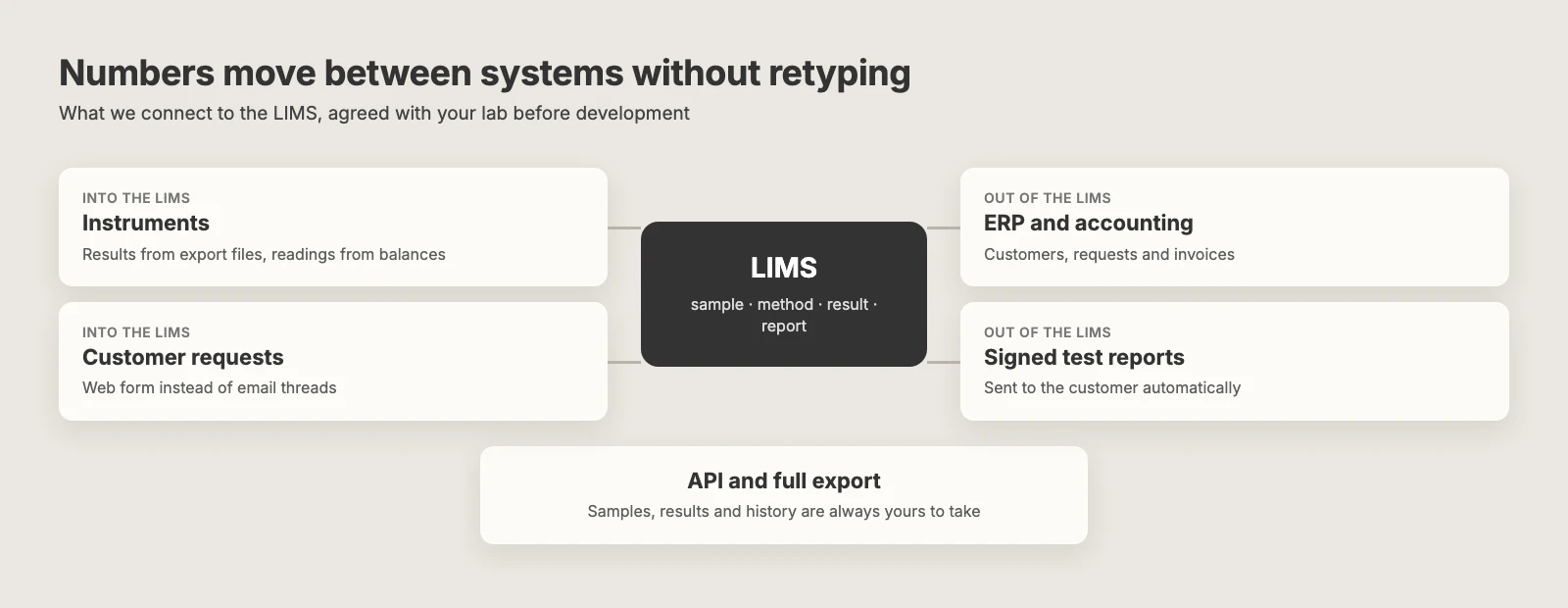
Results move from instruments to the report without retyping, and invoices go out without a manual export. We agree what to connect before development.
Numbers come from the instrument's export file or the balance straight into the sample record, so analysts stop retyping and transcription errors go away. We check which of your instruments can connect before the estimate.
Customers, requests and invoices sync with your ERP or accounting system, so billing no longer depends on a monthly export.
Customers receive signed test reports automatically and send requests through a web form, so your team answers fewer emails.
You can export all samples, results and history at any time, so switching systems later never means losing records.
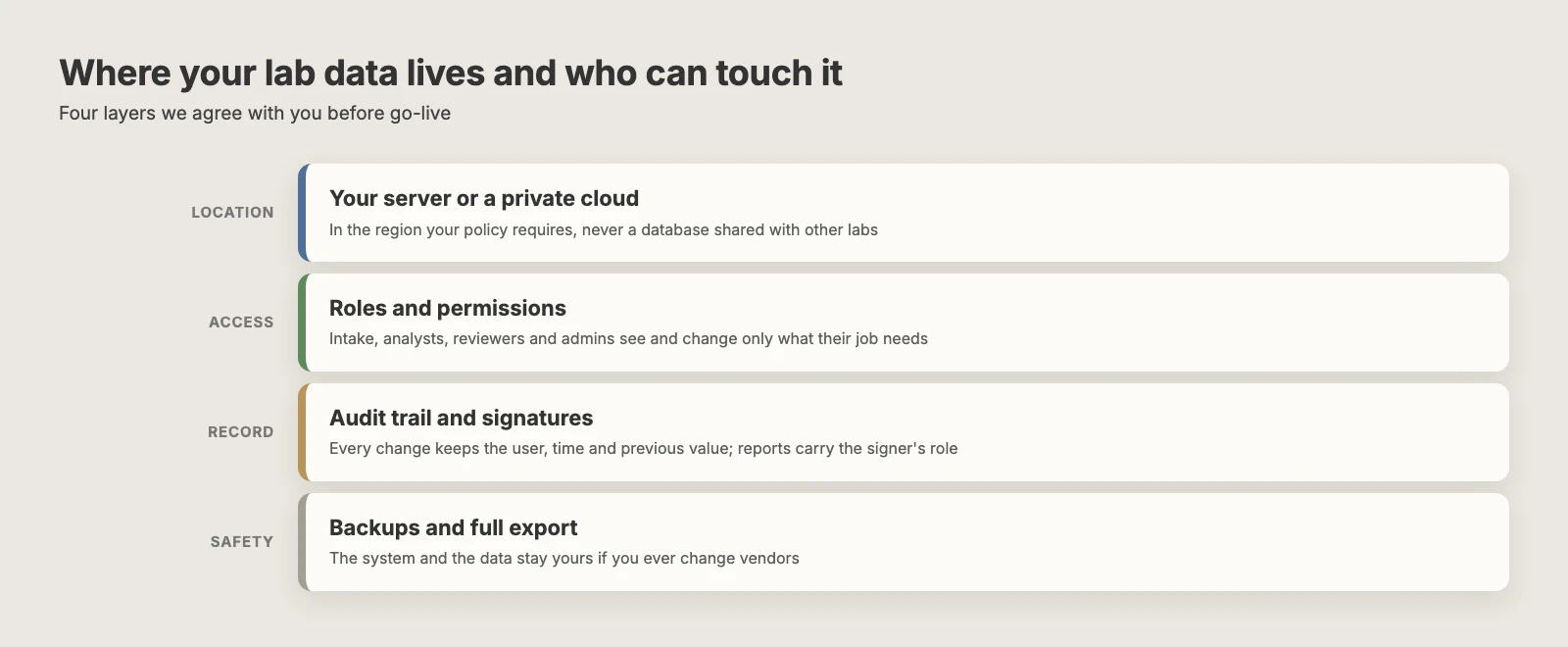
Your data stays where your policy requires, and an assessor can see who did what.
Lab data stays on your own server or in a private cloud in the region you choose, never in a database shared with other labs.
Each person sees and changes only what their job needs, which keeps mistakes and disputes down. Roles are agreed before go-live.
When an assessor or a customer asks who changed a result, you show the previous value, the user and the time. Reports carry the signer's role and timestamp.
Backups run on a schedule and everything can be exported, so the system and the data stay yours even if you change vendors.
If spreadsheets already hurt and a boxed LIMS is neither affordable nor desirable, WAPP can ship a base system free. This is a selective pilot for small teams — not a mass giveaway. There is a queue and an exchange.
Small labs — roughly up to 10 people, anywhere we can work remotely and visit when needed. Base contour: samples and statuses, methods and analytes, signed reports, equipment with calibration, roles, and an action log.
With time and openness: we document the rollout as a public case (anonymized if required). Need it yesterday and fully confidential — commercial development.
A free slot opens when the team has a window. We will not drop paid delivery for a free start tomorrow. Your request joins a live queue.
Backend, instrument interfaces, report templates for your accreditation scope — after the process map. Billing modules, public sample portals, and full multi-site cloud sync are in progress and are not promised on this page.
Spektrokhim — interlaboratory comparisons: rounds, samples, participant results. Adjacent to LIMS work: there we learned that default web UX fails on a chem bench — and carried that into LIMS design.
250 laboratories submit proficiency testing results without email and spreadsheets. A custom LIMS replaced a legacy platform and made reporting 3× faster.
For small labs (roughly up to 10 people) WAPP ships a base version without a license fee: samples, methods, reports, roles, action log. In return — a queue (often 2–4 months) and willingness to publish a case study. Urgent or under NDA — commercial development. Backend, instruments, and accreditation-aligned templates are always priced separately.
Tell us lab size, location, and whether you need a free pilot or a commercial build. We will map processes and say where you land: the queue or a custom quote.