Why labs need custom software — and how we build it

WAPP team
Introduction
Labs can run on off-the-shelf products most companies buy. A custom system can still be the better business move: more orders in less time, fewer manual handoffs, and a real shot at leading a narrow niche.
We built a custom operations platform for Spektrokhim even though we initially knew little about their domain. Here is how we found a shared language with the client — and what we offer teams that have outgrown boxed tools.
How Spektrokhim worked before
Spektrokhim is based in Saint Petersburg. They manufacture precursors (substances used in certain chemical reactions) and certified reference materials with known properties. They also run interlaboratory comparisons / proficiency tests: many labs evaluate the same samples under controlled rounds.
Until 2022, Spektrokhim relied on a well-known German platform for analytics and reporting. It was old, complex, and expensive. Under new economic conditions keeping it became hard. Through a designer contact, Spektrokhim asked us for a more modern, usable replacement.
Much of the work was still manual. Spektrokhim shipped samples to dozens of labs. Each lab was registered for a study; data moved by email. Then the team collated everything and wrote reports. Without automation that took weeks.
Our job was to streamline those processes and deliver a product teams could rely on — without depending on an external vendor’s roadmap or pricing.
Taking on an unconventional brief
Not every vendor likes deep domain complexity. For us it is the interesting work: we unpack what looks opaque and ship what others hesitate to touch.
We grasped the technical shape of the problem quickly. The designer who introduced us had already sketched the UI and gathered requirements with the client. We started from an admin templating stack and extended it to match Spektrokhim’s needs.
Speaking the same language as scientists was not trivial. A Spektrokhim lab specialist helped translate jargon into plain terms — that made delivery possible.
What we shipped
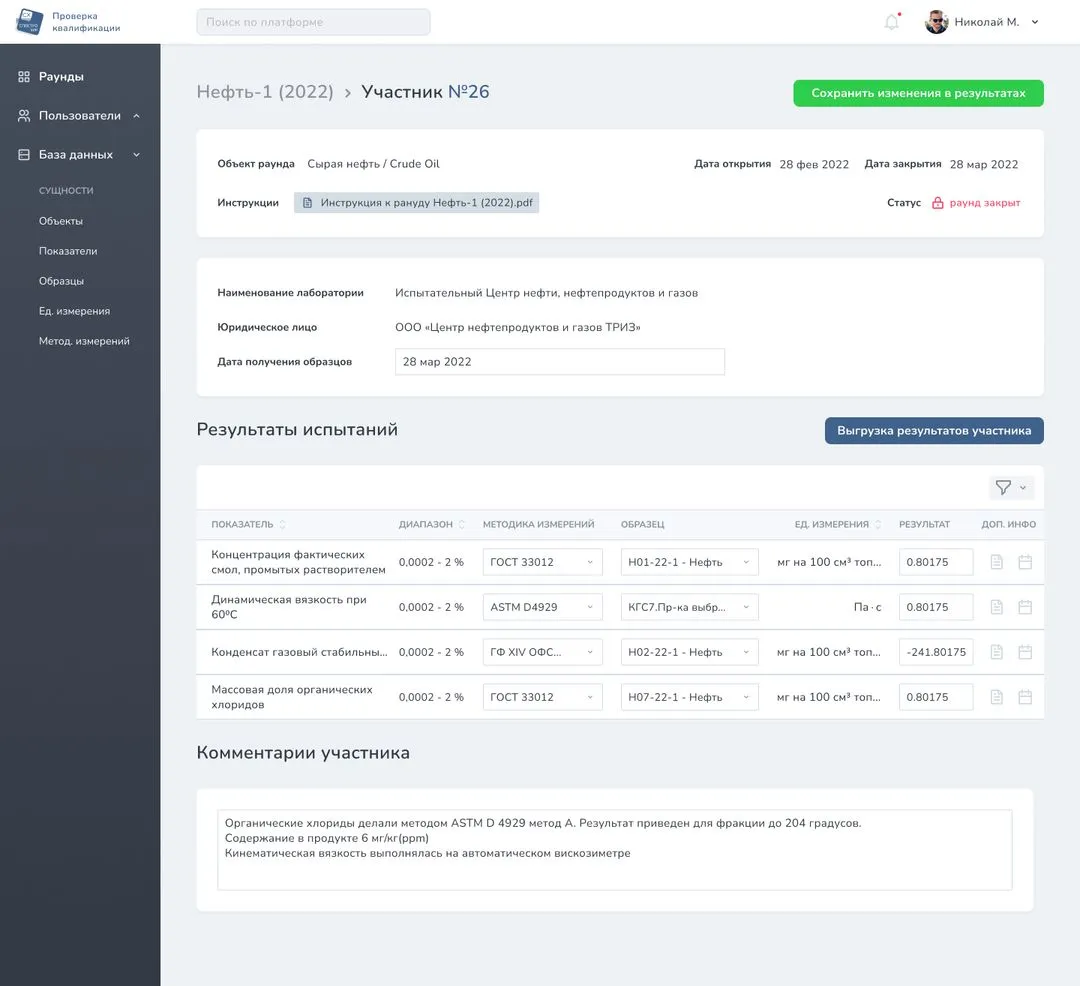
We built a data-reconciliation platform tailored to proficiency-testing rounds: think of an advanced spreadsheet rewritten for lab workflows — fast processing and clear, detailed reports. Similar-looking products exist on the local market; their scope is usually narrower.
Here is what the custom product covers:
- A public form where labs apply to join new study rounds.
- After an interview with an administrator, the system provisions a dedicated lab portal automatically.
- Administrators create and edit study data and test objects.
- Labs enter test results; administrators review and approve them.
- The system rolls everything into a single report exportable to Excel.
- Once a round closes, nobody can change its data — a regulatory requirement for the program.
We aimed to save time for everyone involved. Over time, lab staff can add new methods without calling us. A lead scientist can manage access levels for colleagues. Participants get only the notifications they need. New-round alerts go out automatically to everyone enrolled.
What Spektrokhim gains from the platform
According to Spektrokhim, the product helps the company:
160
active partner labs
320+
lab staff engaged in studies
÷2
fewer corrections vs manual workflows
×3
higher operating speed
Automating applications and processing cut turnaround time. Staff enter and confirm data in one system, which reduces mistakes. Administrators gained practical tools to manage rounds and master data. Labs report that portals are easier to use and results are quicker to access.
What we can offer other clients
We keep a reusable foundation we can adapt for custom products in other industries — then add modules that match the business logic. We pick technologies that are common, maintainable, and cost-effective for the client.
Many sectors struggle with data exchange: legacy standards, incompatible platforms across institutions. Custom software is often the cleanest fix.
Some industries have no real boxed options, yet they still need bespoke engineering. We work with narrow niches — laboratories, logistics, coworking, and education among them.
More on lab systems — on the chemical labs solutions page and LIMS. The Spektrokhim case is also in the project portfolio.
Why companies invest in custom solutions
Custom software is a business asset: you invest first, then earn returns. For example, you can:
- monetise data you already collect;
- hire for clearer roles, spend less time recruiting specialists, and reduce payroll pressure;
- take on more orders;
- run more studies with less time and fewer resources;
- avoid expensive third-party subscriptions typical of boxed suites.
Teams often do not know how to start a custom project or write a solid specification. The shortcut is to talk to us. We clarify what you need, shortlist industry-relevant options, compare them with bespoke development, and give frank recommendations. We surface unmet needs, simplification wins, and delivery risks — then produce a clear specification and timeline. Whatever sector you are in, we can usually find a path to higher operational efficiency.