Mobile App Development Cost in 2026: What Studios Don't Put in the Quote


The dream of launching an app usually starts with a spark of genius and a quick Google search: "How much does it cost to build an app?" If you were looking for a simple number, I have some news that might be uncomfortable but necessary. In 2026, the traditional "price tag" model is dead.
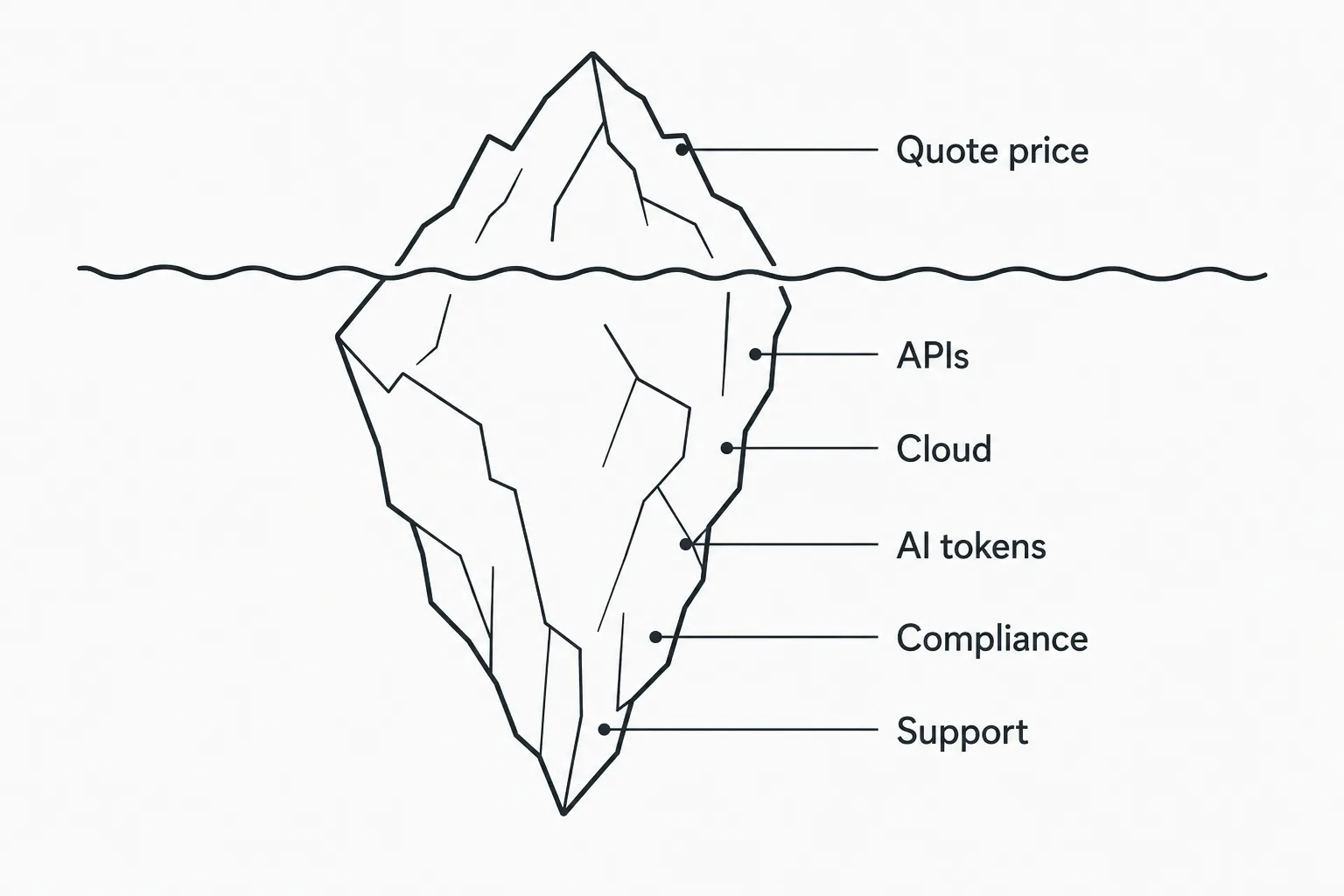
Building an app today isn't just about hiring someone to write code; it's about architecting a digital ecosystem that survives in a world of hyper-personalized AI, fluctuating cloud costs, and rigorous data privacy laws. If you walk into a development studio today, they will give you a quote. But that quote is often just the tip of the iceberg. To truly succeed, you need to understand the submerged costs that can sink a project before it ever hits the App Store.
The Reality of App Budgeting in 2026
Budgeting for an app in 2026 feels different than it did even three years ago. We've moved past the "gold rush" era where any functional interface could find an audience. Now, users expect magic, and magic has a specific overhead.
Why "Ballpark Estimates" are Vanishing
In the past, a developer could look at your feature list and give you a rough estimate because most apps followed a predictable blueprint. You needed a login, a database, a shopping cart, and a payment gateway. Today, even simple social networking apps might require real-time video processing, computer vision for AI-driven content moderation, and cross-platform synchronization that works across a widening range of devices.
Because the baseline for "standard" features has shifted so drastically toward high-end tech, ballpark estimates have become dangerous. The variance that used to sit inside a rounding error now sits inside a funding round. Developers are realizing that if they give you a fixed number too early, they are either guessing or setting themselves up for a loss they will try to recover through change orders later.
The Shift from Coding to Orchestration
We are no longer in an era where developers write every line of code from scratch. Modern development is about orchestration. Your app is a symphony of third-party APIs, cloud services, and pre-built frameworks.
The cost has shifted from the labor of typing syntax to the expertise of integrating complex systems. You aren't just paying for hours spent coding; you are paying for the strategic thinking required to ensure that your AI assistant doesn't hallucinate and your payment processor doesn't fail during a regional outage. This shift means that while coding gets faster thanks to AI-assisted tools, engineering becomes more expensive, because the stakes of a bad architecture are higher than ever.
Breaking Down the Core Development Costs
To understand where your money goes, we have to look at the pillars of construction and how app complexity dictates the final price. Think of it like building a house: the price changes based on whether you're building a prefab cabin or a high-tech smart home.
1. Complexity Levels: MVP vs. Enterprise
An MVP (Minimum Viable Product) in 2026 is no longer "bare bones." It must be loveable. It needs to solve one problem well with a polished UI. It is designed to test a hypothesis with real users without over-investing in bells and whistles: two user roles, one core scenario, and enough quality that people don't uninstall on day one.
Enterprise apps, on the other hand, are built for scale, security, and legacy integration. They often require compliance certification, multi-factor authentication, and the ability to handle heavy concurrent load. The budget gap between the two is not incremental — it is an order of magnitude, because the work is fundamentally different. An MVP validates an idea. An enterprise app becomes the backbone of a company's operations, and it has to behave like one on the worst day of the year, not the best.
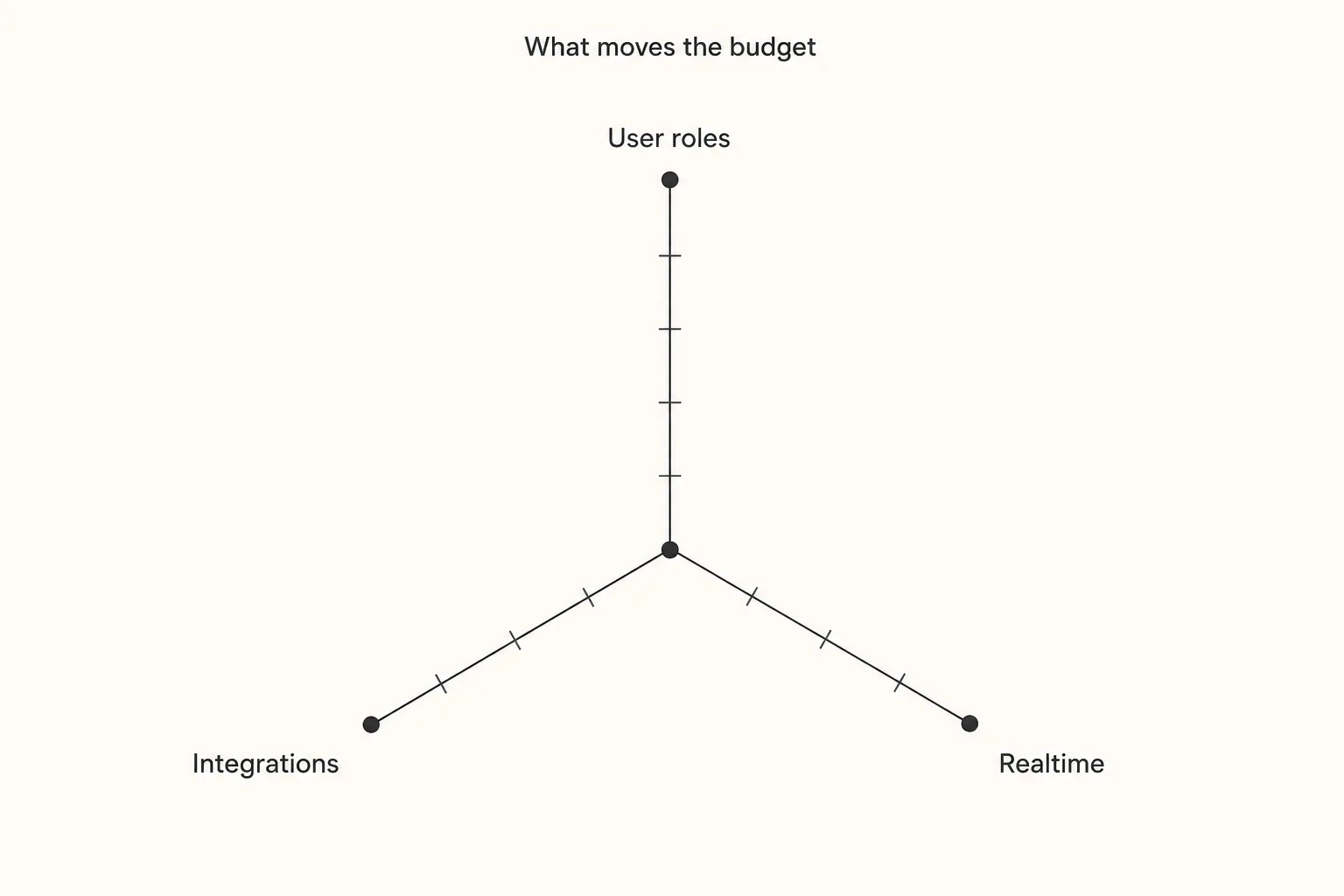
What actually moves the number inside each tier: the count of user roles, the number of external systems you integrate with, and whether anything happens in real time. Three roles cost far more than two, not because of extra screens, but because every permission boundary has to be designed, built, and tested.
2. The Platform Choice: Native vs. Cross-Platform
The "native vs. cross-platform" debate has largely been settled by the maturity of frameworks like React Native and Flutter. For most business applications, cross-platform development is the sensible default. It allows you to write one codebase for both iOS and Android, which meaningfully reduces initial development cost — though not by half, since platform-specific work, testing, and store submission still happen twice.
However, if your app requires high-performance graphics, heavy background processing, or deep integration with specific hardware, native development (Swift for iOS, Kotlin for Android) is still the right call. Just be prepared to pay for two codebases and two release cycles.
Our own split follows that logic. Glinka Digital, a platform for online music lessons, runs on React Native because the interface is standard and the difficulty lives on the backend. When the hard work is media and infrastructure rather than UI chrome, cross-platform on the front is what frees budget for the parts that actually differentiate the product.
3. UI/UX Design: Why "Pretty" Isn't Enough Anymore
In 2026, design is about frictionless flow. A beautiful e-commerce app that takes three taps to reach checkout will lose to an average-looking app that takes one. UX designers now spend as much time on data, psychology, and accessibility as they do on colors and fonts.
Good design involves user journey mapping, wireframing, and interactive prototyping. If the design line in your quote looks suspiciously thin, the studio is likely skipping research — which means you'll pay for it later, when you redesign because users can't figure out how to use what you built.
4. The Backend Infrastructure and Data Management
The backend is the engine under the hood. In 2026, this isn't just a database. It involves serverless architectures, real-time data streaming, and edge computing to keep latency low. The cost here is driven by the volume and shape of the data you expect to process. If you're building a video platform, your backend will dwarf your frontend. If it's a scheduling tool, the backend and admin panel stay relatively light.
What Studios Don't Put in the Initial Quote (Hidden Costs)
This is where most founders get blindsided. A studio quotes the construction of the app, but rarely the operating costs or the "last mile" expenses.
1. API Licensing and Third-Party Integrations
Almost every modern app relies on other software. Need a map? You'll pay Google Maps. Push notifications? Firebase or OneSignal. Text messages? Twilio. Payments? Your processor takes a cut. These aren't one-time fees; they are ongoing operational expenses that scale with your usage.
In your first year, if you haven't budgeted for these API costs, they quietly eat into your margins. Premium AI APIs are priced per request, which sounds trivial until you multiply by your daily active users.
2. Cloud Infrastructure and Scaling Fees
Studios often build in a sandbox environment. When you go live, you pay for hosting. The trap here is auto-scaling: if your app goes viral, your cloud provider spins up more capacity automatically and sends you the bill at the end of the month. You need someone to set guardrails and alerts on these costs — something rarely included in a basic development quote.
3. The "AI Premium": Training and Token Costs
If your app features a smart assistant or personalized recommendations, you are entering the world of large language models. Whether you use a commercial API or host an open model yourself, there is a per-token cost for everything the model reads and writes. If you need to fine-tune on your own data, the engineering hours and compute required are a separate line entirely.
4. App Store Deployment and Compliance Audits
Getting into the App Store isn't as simple as clicking upload. You need to meet Apple's and Google's ever-changing guidelines, and store fees apply to any in-app revenue. More importantly, if you handle user data under GDPR, CCPA, or HIPAA, you may need a formal security audit. Fintech and healthcare apps frequently require third-party penetration testing, and that is almost never in the initial dev quote.
Regional Pricing: Where is Your Talent Located?
Geography remains a major lever in your budget. The ranges below reflect commonly reported market rates from directories like Clutch and GoodFirms — treat them as orientation, not as quotes, since they shift with demand and seniority.
North America and Western Europe
You are paying for proximity, cultural alignment, and often better legal protection. If you are a well-funded startup that values same-timezone communication above all else, this is the premium option — and the burn rate reflects it.
Eastern Europe and Latin America
Strong engineering education, established outsourcing markets, and workable timezone overlap with either the US or Western Europe. Rates sit meaningfully below North America without a corresponding drop in engineering quality.
South Asia
The most budget-friendly tier, but it carries a management overhead. To succeed, you need very clear documentation and usually a dedicated project manager on your side. The risk is rarely code quality — there are excellent engineers in the region — it's requirements getting lost in translation.
Strategic Ways to Lower Your Development Cost
Lowering cost doesn't mean cutting corners; it means being smarter about how you build.
Start with a Product Discovery Phase
Spend two weeks mapping the product before spending months building it. In discovery you validate assumptions, map the technical architecture, and identify deal-breakers. Changing a feature on a whiteboard is dramatically cheaper than rewriting the module that depends on it.
Prioritize a Tight MVP
The biggest budget killer is "what if" syndrome. What if we added a social feed? What if users want a dark theme? Every "what if" adds hours. Stick to the core problem. If it's a delivery app, the only questions that matter are: can they find food, can they pay, can the driver find them. Everything else is version two.
Use Open-Source Libraries Wisely
Don't reinvent the wheel. If there's a well-maintained library for a chat interface or a charting tool, use it. Your developers should be building the unique value of your business, not the standard components the community perfected a decade ago.
Continuous Testing to Avoid Technical Debt
If you wait until the end of the project to test, you'll find bugs baked into the foundation. A defect caught during the sprint it was written in is a small fix. The same defect found after launch may require unpicking everything built on top of it. Continuous QA is not a cost center; it's insurance against a rewrite.
Comparing Development Models
How you hire is just as important as who you hire.
Hiring an Agency vs. Freelancers
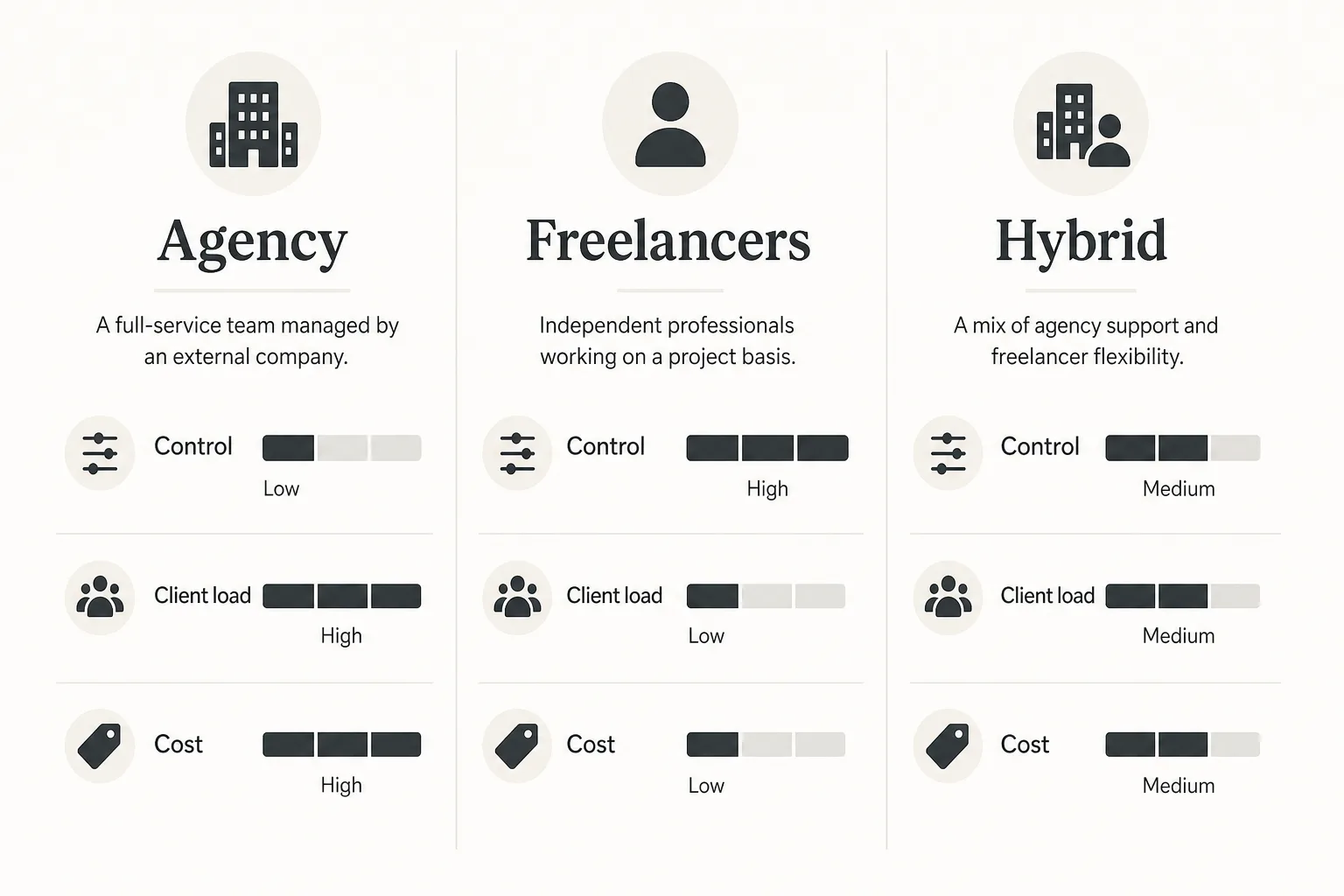
An agency provides a full team: project manager, designer, frontend, backend, QA. They have internal processes and accountability. You pay a premium for that structure, but it removes management load from you.
Freelancers are cheaper, but you become the project manager. If your lead developer disappears for a week, your project stops. Use freelancers when you have the technical knowledge to manage them, or when the task is small and well-defined.
Building an In-House Team: The True Cost
Many founders think in salaries alone. But an in-house team costs far more than that: benefits, equipment, software licenses, workspace, and the substantial time cost of recruiting and onboarding. This usually becomes viable only once you have consistent revenue or funding to support a permanent payroll.
The Hybrid Approach
This is the modern winner for most companies. You keep a product owner or CTO in-house to own the vision and the keys to the code, and outsource the heavy lifting to a trusted team. You get the control of in-house with the cost profile of outsourcing.
How This Plays Out on Real Projects
Abstract cost tiers only get you so far. Here is how the trade-offs looked on three of our own projects.
Real-time video for music lessons — Glinka Digital
The challenge: teaching music over video, where compressed audio destroys exactly the detail a teacher needs to hear.
The approach: React Native for the interface, since the screens are conventional, with the engineering effort concentrated on the media pipeline and the backend.
The lesson: when the hard part is real-time media, the budget belongs on the backend, not the UI. Cross-platform on the front is what freed the budget to spend there.
Fleet management MVP in 90 days — SWAPPZ
The challenge: an electric vehicle rental operator in the UAE needed a working platform with five distinct user roles inside a hard 90-day deadline.
The approach: scope frozen early, architecture decided upfront, sprints used to sequence delivery rather than to renegotiate requirements.
The lesson: a hard deadline is itself a budget constraint. Narrow scope is what makes complex role models shippable in a quarter.
A payments company website — LIFE PAY
The challenge: a corporate site that generated leads every day and could not go dark during a redesign.
The approach: several template generations coexisting in one codebase, with routes switched over page by page. Legacy URLs kept working and the lead funnel was never rebuilt from scratch.
The lesson: incremental migration costs more in engineering time than a rewrite, and less in lost revenue and lost search rankings. That trade is usually worth making.
Common Budget Killers (And How to Avoid Them)
Scope Creep: The Silent Budget Destroyer
Scope creep happens when you add "just one little thing" every week. Individually these seem small. Collectively they push a project months past its deadline. The fix is a Phase 2 list: every new idea goes on it, and nothing comes off it until the MVP is live.
Underestimating QA
Testing is not a final check. It is a rigorous process of trying to break the app. If you don't budget for professional QA, your users become your testers — and in 2026 a crash on first launch usually means a permanent uninstall.
Ignoring Marketing and User Acquisition
This isn't a development cost, but it kills budgets because it's forgotten. If you spend everything on building and nothing on telling people, you have an expensive paperweight. Set aside a meaningful reserve for launch marketing and app store optimization before you commit the last of your budget to features.
Choosing the Right Partner for Your Vision
Picking a developer is like picking a co-founder. You're going to be in the trenches together for months.
Red Flags in a Developer's Quote
The yes-man. If they agree to every feature without asking why, or how it makes money, they're billing hours, not building a product.
A firm price for vague specs. If they give you a confident number after a ten-minute call, they will either cut corners or come back with change orders that double it.
No mention of post-launch support. An app is a living thing. If the quote ends the day it hits the store, walk away.
Questions You Must Ask Before Signing the Contract
- How do you handle technical debt during the build?
- Can I see a breakdown of the third-party API costs I should expect?
- Who owns the intellectual property and the source code at every stage? (It should be you.)
- What is your process for security testing and data privacy?
Final Thoughts: Thinking Beyond the Launch
By 2026, "build it and they will come" has been thoroughly debunked. The cost of an app isn't a hurdle to clear; it's an investment in a business engine.
As you move forward, remember that launch day is day zero. The real work — and a large share of the real cost — comes from reacting to user feedback, keeping up with OS updates, scaling infrastructure, and staying ahead of competitors. Plan for the hidden costs now, prioritize ruthlessly, and choose a partner who challenges your assumptions.
The quote you get from a studio is the start of a conversation, not the end of it. If you want that conversation to start with a realistic scope rather than an optimistic number, talk to our team — we map constraints to a delivery model before anyone writes code. For how delivery models fit constraints, see also SDLC methodologies compared.