SDLC Methodologies Compared: Waterfall, Agile and DevOps in Practice

The Software Development Life Cycle (SDLC), also known as the systems development life cycle, is not a suggestion; it is a manufacturing pipeline and software development process for digital assets. In the business world, code is liability until it is deployed. How you manage that transition from liability to asset determines your ROI, your speed to market, and your technical debt.
Choosing a methodology is a capital allocation and project management decision. Whether you opt for the rigid discipline of Waterfall, the iterative speed of an iterative model like Agile, the risk-focused spiral model, or other software development models like the continuous flow of DevOps, you are making a bet on how your organization handles uncertainty and change. This article deconstructs the SDLC to provide a pragmatic roadmap for that decision.
The Business Case for Choosing the Right SDLC
Efficiency in software development is measured by the reduction of waste. Waste manifests as unused features, extensive bug fixing, or missed market windows. If you choose the wrong methodology, you are essentially subsidizing inefficiency.
A startup building a disruptive app cannot afford the long lead time of a traditional Waterfall process. Conversely, a bank upgrading its core ledger cannot risk the "move fast and break things" ethos of pure Agile. Your choice of SDLC dictates your cost of failure. By aligning your methodology with your business goals, you minimize the "pivot cost" — the price you pay when reality disagrees with your initial project plan.
The 7 Standard Stages of the SDLC
The SDLC is often drawn as a straight line. In practice it is a loop, and the methodology you pick decides how tight that loop is.
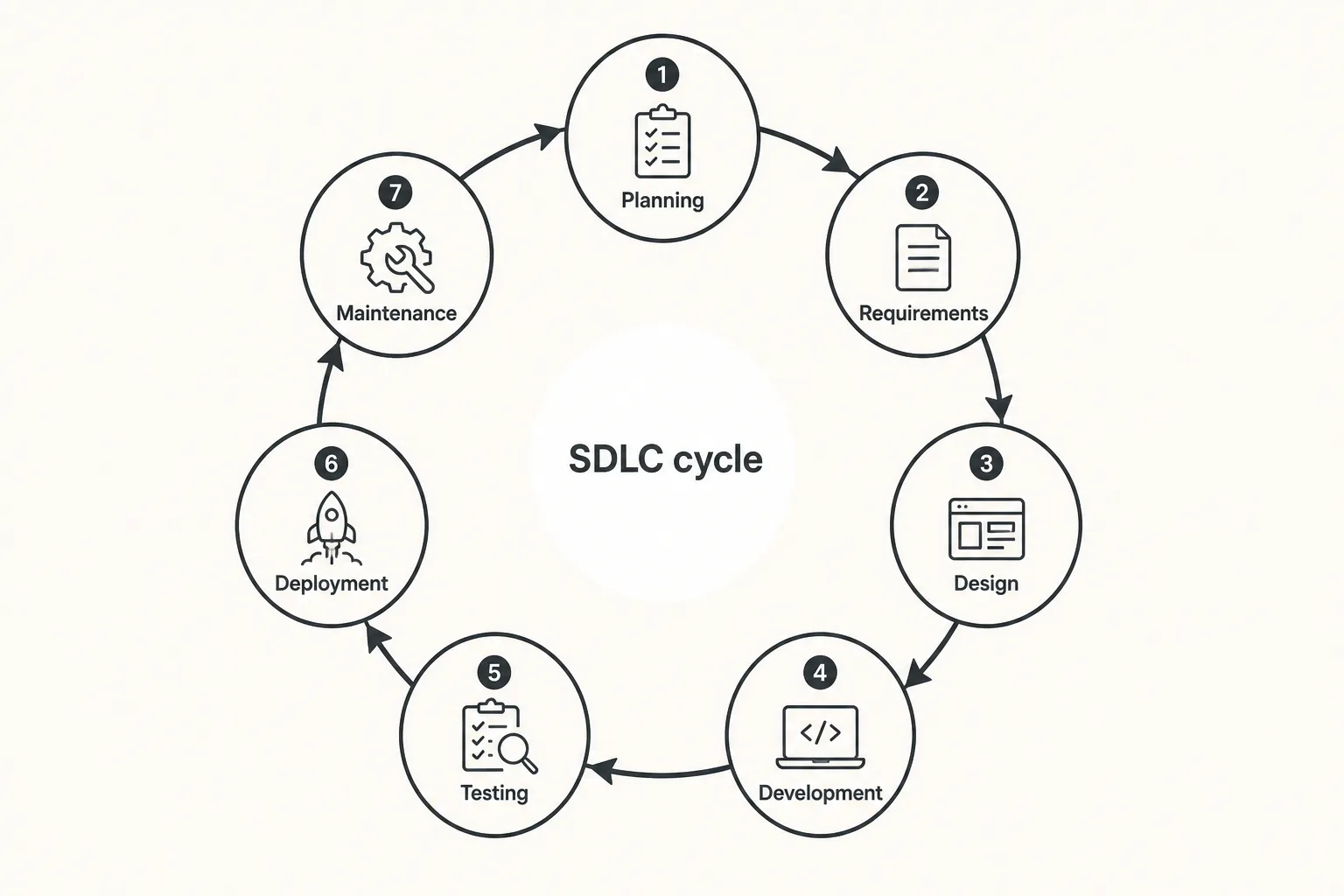
Regardless of the methodology, every software project moves through these seven fundamental stages of the SDLC. The difference lies in how often you repeat them and how much time you spend in each.
1. Planning and Requirement Analysis
This is the most critical phase, encompassing comprehensive requirements gathering. You define the "Why." You assess feasibility, allocate resources, identify risks, and may engage in early prototyping. If your planning is flawed, your code is irrelevant. Business leaders, stakeholders and business analysts must define the problem before software engineering teams define the solution.
2. Defining Requirements (SRS)
Here, you translate business goals into a Software Requirement Specification (SRS). This document bridges the gap between stakeholders and developers. It defines what the system must do, excluding any ambiguity. In Waterfall, this document is a contract; in Agile, it is a living backlog.
3. Product Architecture and Design
Design is not about aesthetics; it's about structure. Architects create the Design Document Specification (DDS), outlining the system design and system architecture, data flow, third-party integrations via APIs, and modularity. Good design, including a robust database design, ensures that a change in one module doesn't collapse the entire stack.
4. Building and Developing the Product
This is the execution phase. Developers write the code based on the DDS. If the previous stages were handled correctly, this stage is a mechanical translation of design into logic. If they were skipped, this stage becomes an expensive exercise in improvisation.
5. Testing and Quality Assurance
Testing, including rigorous integration testing, system testing, and user acceptance testing, is the gatekeeper of your reputation. You verify that the code meets the SRS requirements and is free of critical bugs. Modern systems prioritize automated unit testing, documented test cases, and peer code reviews to ensure that new code doesn't break old functionality (regression).
6. Deployment in the Market
The code moves to the production environment. This can be a release following the big bang model where everything goes live at once, or a "Canary" release where the software is rolled out to a small subset of users to monitor performance.
7. Operations and Maintenance
The software development life cycle doesn't end at launch, as it requires a commitment to continuous improvement and robust application lifecycle management. Software is organic; maintenance means updates, patches, security fixes and scaling. A significant share of the total cost of ownership accumulates here rather than during the initial build. Ignore maintenance, and your product will suffer from "bit rot."
Waterfall: The Linear Path to Predictability
Structural Logic: The Sequential Flow
The waterfall model is the "measure twice, cut once" approach, often grouped with the V-model and contrasting sharply with the iterative agile model. It is a linear, non-overlapping sequence: Requirements → Design → Implementation → Verification → Maintenance. You cannot move to the next step until the previous one is signed off. It assumes that the requirements are known and will not change.
When Waterfall Makes Financial Sense
Waterfall is the most efficient choice for fixed-price contracts with static requirements. If you are building a regulated medical device interface or a system with a certified specification, you need the predictability Waterfall provides. It allows for precise budgeting and clear milestones.
The Hidden Costs of Rigidity
The cost of change in Waterfall grows sharply the later it arrives. A requirement discovered during testing is dramatically more expensive than the same requirement caught during planning, because it invalidates design decisions already implemented. Because testing happens at the very end, you may discover a fundamental flaw only after most of your budget is spent.
Efficiency Metrics: Predictability vs. Adaptability
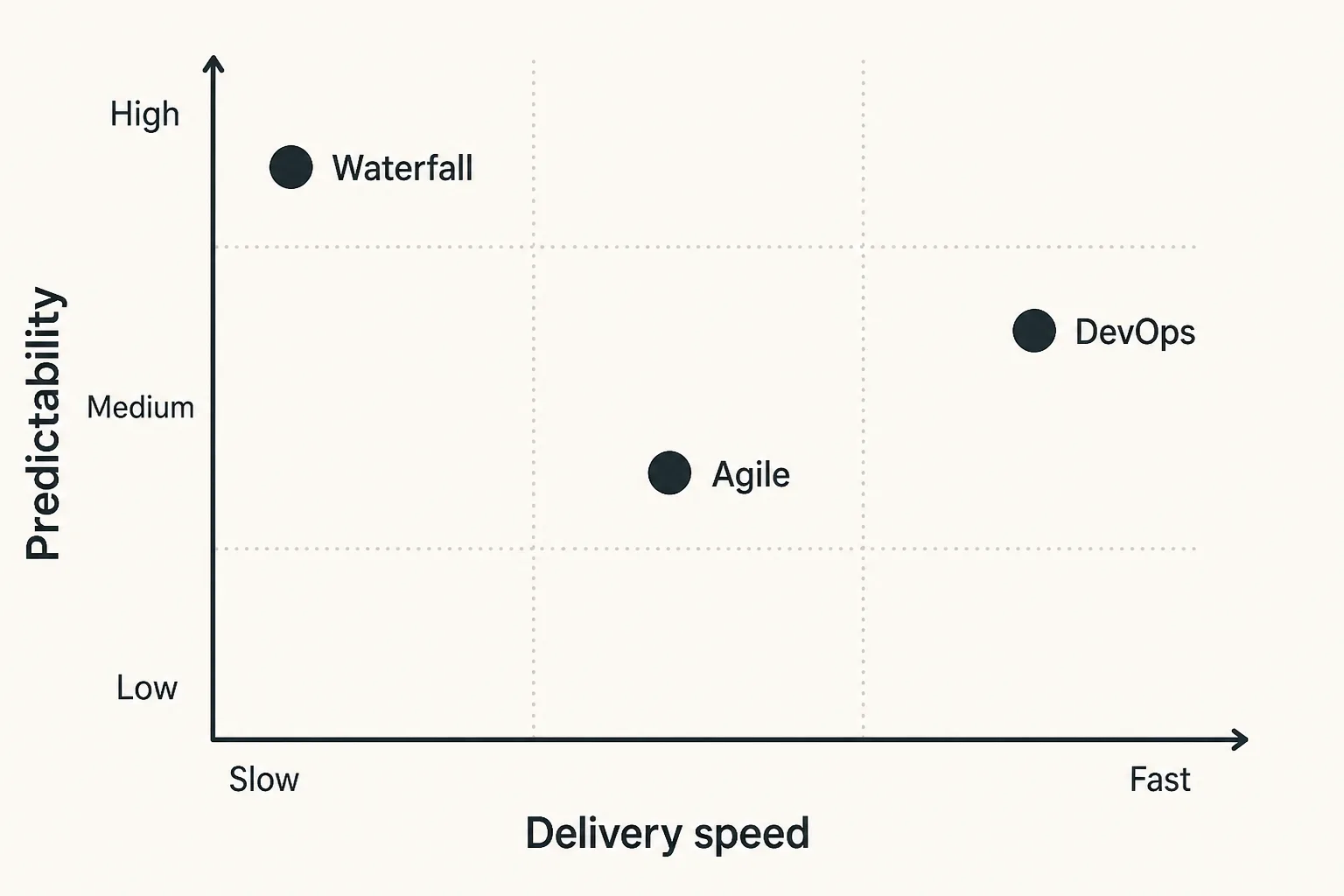
Waterfall remains the reference point every other software development life cycle model is measured against.
Strength: highly predictable timelines and budget variance.
Weakness: near-zero adaptability. If the market shifts mid-project, you are left with a perfectly executed, useless product.
Agile: Optimizing for Change and Iteration
The Shift from Projects to Products
Agile treats software as a living product rather than a one-off project. It breaks development into small, time-boxed increments called sprints (usually 2–4 weeks). Each sprint results in a working piece of software. This allows you to pivot based on real-world feedback rather than theoretical assumptions.
Common Agile Frameworks in Practice
Scrum: focused on roles (Scrum Master, Product Owner) and ceremonies (daily standups, sprint retrospectives).
Kanban: focused on flow and work-in-progress limits. It visualizes the pipeline to identify bottlenecks.
Velocity vs. Scope: Managing Client Expectations
In Agile, you don't fix the scope; you fix the time and the resources. You measure velocity — how much work the team completes in a sprint. This requires a shift in mindset: the client must accept that they won't know exactly what the final product looks like on day one, but they will have a working version much sooner.
The Downside: The "Forever Project" Risk
Without a disciplined Product Owner, Agile can lead to scope creep and never-ending development cycles. Because there is no fixed end date, costs can spiral if the team keeps adding features without ever achieving a definitive version 1.0.
DevOps: Merging Development and Operations
Beyond Methodology: A Culture of Continuous Delivery
DevOps is not just a way to write code; it's a way to run a business. It removes the silos between the people who write the software and the people who maintain the infrastructure. The goal is continuous delivery — the ability to push code to production at any time with high confidence.
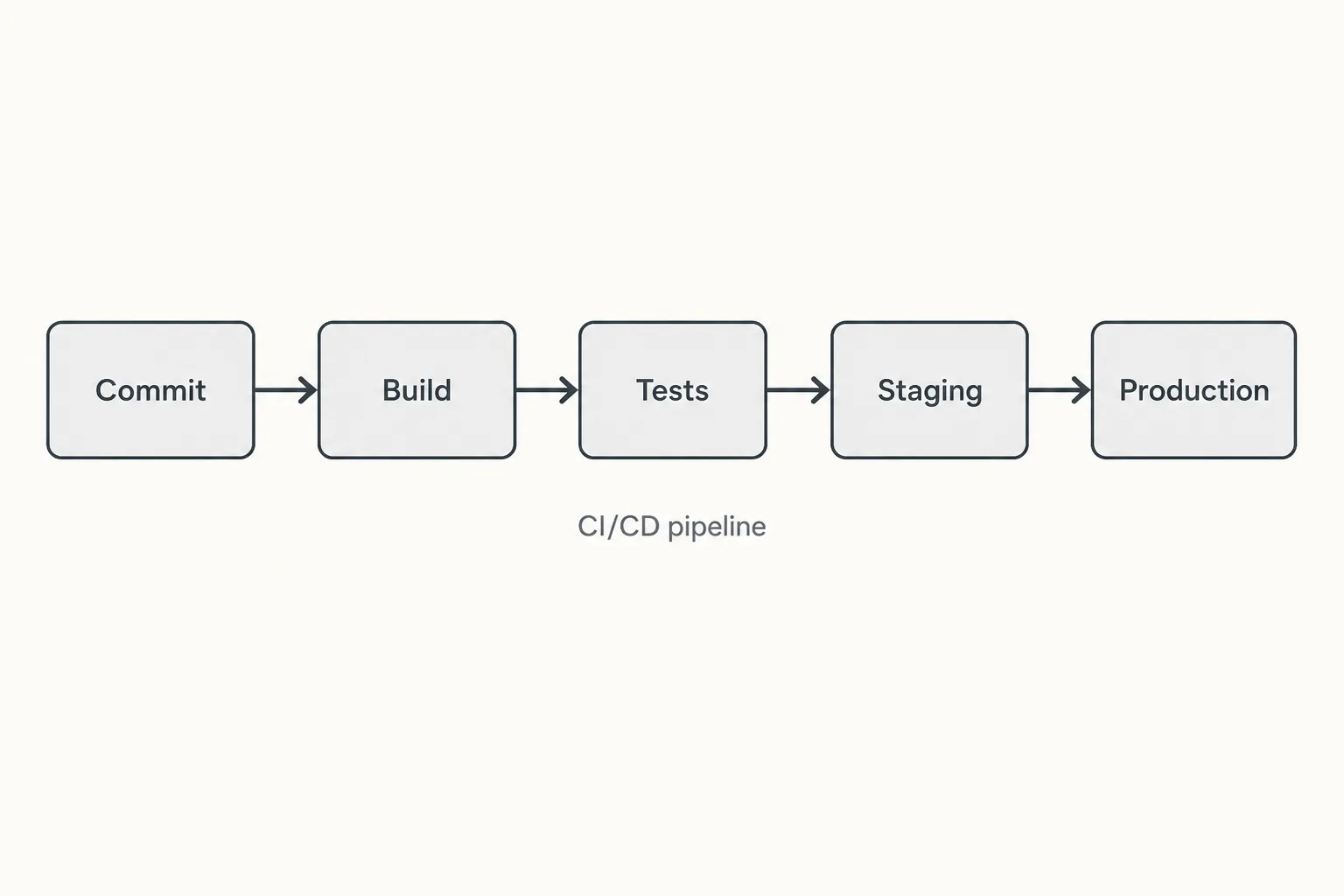
The CI/CD Pipeline: Automating the SDLC
The heart of DevOps is the CI/CD pipeline. Continuous integration means every commit is automatically built and tested. Continuous deployment means that if the tests pass, the code moves to staging or production without manual steps. This reduces the human error factor in deployment close to zero.
What the DevOps Advantage Actually Buys You
Teams with mature CI/CD deploy far more frequently than teams relying on manual releases, and they recover from failures faster because each change is small enough to isolate. In business terms: you can respond to a competitor's feature or a critical security bug in hours instead of weeks. Industry benchmarks on deployment frequency and change failure rate are published annually in the DORA State of DevOps reports, and they are worth reading before you commit budget to a transformation.
Prerequisites for DevOps Implementation
You cannot buy DevOps. It requires investment in automation tooling (Docker, Kubernetes, CI runners), an understanding of microservices, security testing and penetration testing built into the pipeline (DevSecOps), and a cultural shift where developers take responsibility for how their code behaves in the real world.
Side-by-Side Comparison
| Metric | Waterfall | Agile | DevOps |
|---|---|---|---|
| Timeline | Long (months/years) | Iterative (weeks) | Continuous (hours/days) |
| Delivery speed | Slow | Moderate | Very fast |
| Budgeting | Fixed / predictable | Variable / per sprint | Variable / operationalized |
| Risk management | High, back-ended | Moderate, sprint-level | Low, automated and constant |
| Client involvement | Start and end only | Frequent | Continuous feedback |
Cost Structure and Budgeting
Each SDLC model distributes spend differently across the timeline.
Waterfall favours capital expenditure with a large upfront investment. Agile and DevOps shift toward operating expenditure, requiring a steady monthly burn rate to maintain a dedicated team.
Risk Mitigation Strategies
Waterfall mitigates risk through documentation. Agile mitigates risk through frequent demos. DevOps mitigates risk through automation and failing fast on a small scale before issues become systemic.
Client Involvement and Feedback Loops
Waterfall assumes the client knows what they want. Agile assumes the client thinks they know what they want but will change their mind. DevOps assumes the data will tell everyone what the client actually needs.
How We Apply This in Practice
Methodology debates are cheap. What matters is which constraints you are actually operating under, and how project management adapts to them. Here is how the choice plays out on real projects at WAPP.
Fixed scope and a hard deadline → structured delivery. For SWAPPZ, a fleet management platform for electric vehicle rental in the UAE, the client needed a working MVP with five user roles inside 90 days. That constraint made the plan non-negotiable: scope was frozen early, architecture decided upfront, and the sprints existed to sequence delivery rather than to renegotiate requirements. Pure Agile would have invited scope creep the deadline could not absorb.
A live product that cannot go dark → incremental migration. The corporate site we built for LIFE PAY, a payments company, went through several design generations while continuing to generate leads every day. Four template layers coexisted in one codebase, and routes were switched over page by page. Legacy URLs kept working, analytics stayed intact, and the lead funnel was never rewritten from scratch. A big bang release would have cost the client search rankings and attribution data.
A long-lived system with many editors → maintenance as a first-class phase. For Skoltech, a research university, the platform is operated by more than fifty administrators publishing thousands of pages. Here the interesting work is not the initial build; it is the modular admin, the role model and the release process that let non-developers ship content safely for years after launch.
The pattern across all three: the software development life cycle follows the constraint, not the other way round. Deadline-driven work needs structure. Living products need incremental delivery. Long-horizon systems need maintenance designed in from stage one.
Common Pitfalls in SDLC Transitions
The "Agile-in-Name-Only" Trap
Most failed SDLC transitions fall into one of three patterns.
Many companies claim to be Agile but still require fifty-page requirement documents and three months of approvals. This is Waterfall with standups. It offers none of the speed of Agile and all of the confusion of missing documentation.
Over-Engineering the Pipeline
For a small team, setting up a complex DevOps pipeline can be a waste of time. If you spend forty hours automating a task that takes five minutes once a month, you have failed the business logic test. Automation must have a clear return.
Ignoring the Human Element
DevOps fails when it's treated as a purely technical problem. If your operations team is incentivized to keep the system stable by saying no to changes, and your development team is incentivized to ship features by saying yes, no amount of automation will fix that conflict of interest.
The Future of SDLC: AI and Low-Code Integration
The next evolution of the SDLC is the integration of generative AI. We are moving toward a synthetic SDLC where AI handles boilerplate coding and parts of automated testing, allowing humans to focus on planning, requirements analysis and architecture.
Simultaneously, low-code platforms are compressing the life cycle for simple business applications. This doesn't replace the developer; it elevates them. The developer becomes an orchestrator of systems rather than a writer of syntax in a specific programming language. Efficiency will no longer be measured by lines of code, but by the speed of the concept-to-cash cycle.
Final Assessment: Efficiency is the Only Metric That Matters
There is no best methodology — there is only the methodology that fits your constraints.
Use Waterfall when the cost of an error is physical, regulated or contractual. Use Agile when the market is uncertain and you are still looking for product-market fit. Use DevOps when your software is your business and downtime or slow updates are unacceptable.
The goal of any SDLC is a repeatable, predictable pipeline that delivers value, and sound project management is what keeps it repeatable. If your current process feels like a hurdle rather than a highway, you aren't just using the wrong methodology — you're losing money.
If you are weighing these trade-offs on a specific project, talk to our team. We will map your constraints to a delivery model and give you a realistic scope, timeline and budget before any code is written. For what studios leave out of app quotes — APIs, cloud, AI tokens, compliance — see Mobile app development cost: the hidden line items.