How much does mobile app development cost: what drives the price and real budgets

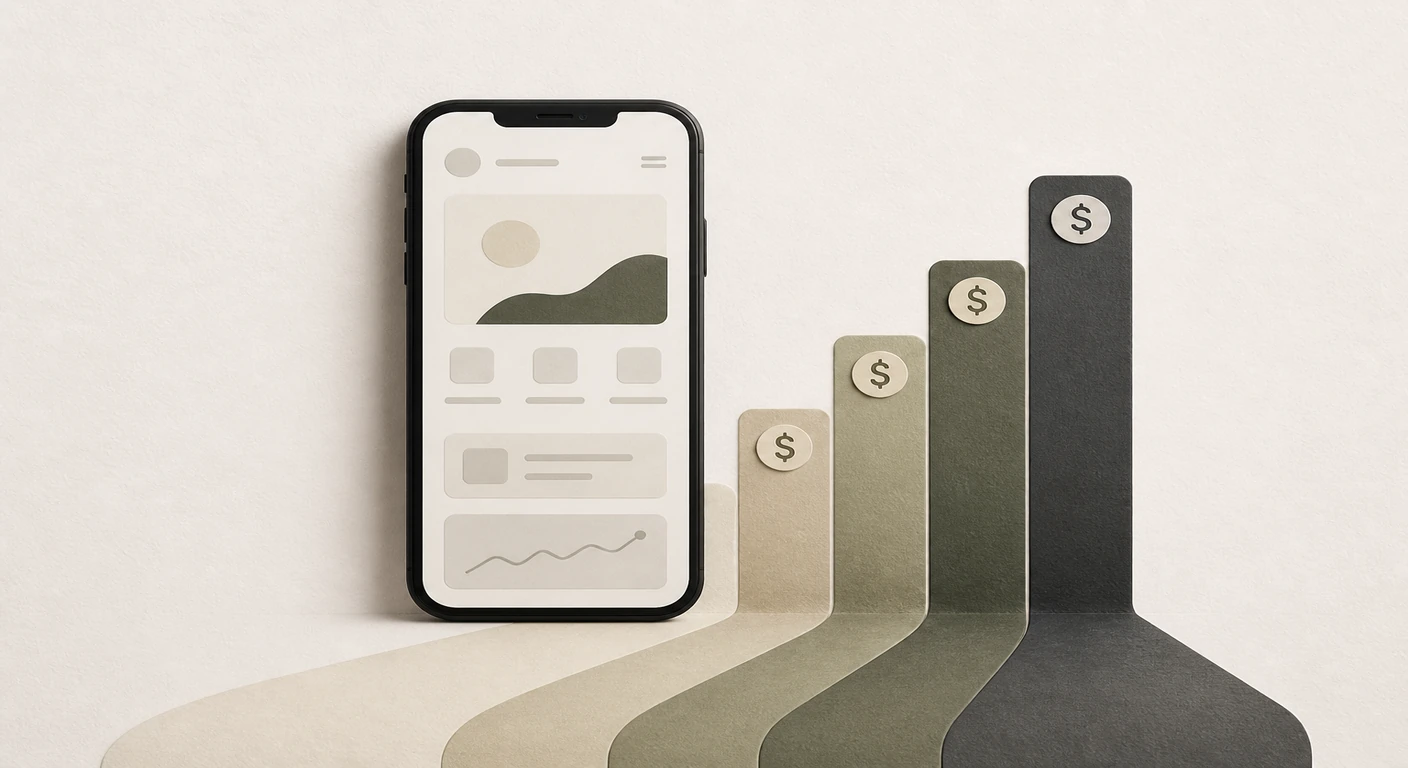
Five commercial proposals for the same mobile app. Prices: RUB 200K, 800K, 2.5M, 4M, and 8M. Every vendor calls their estimate “market rate.” Sound familiar? In eight years, WAPP has seen this spread dozens of times — and the main reason is almost always the same: each company includes a different scope in the cost of mobile app development. Some quote code only; others add analytics and design; others honestly include server infrastructure, testing, and post-launch support. Here is what actually drives the price, so when you compare proposals you compare like with like.
What makes up the cost of mobile app development
Analytics and discovery: about 15% of budget
Mobile app development does not start with code — it starts with questions. An analyst gathers requirements, studies competitors, maps user scenarios, and produces a technical specification. The output is a spec, screen maps, and a prototype. This stage takes two to six weeks and is about 15% of the project budget.
Skipping analytics means baking in risk: without a spec, developers fill gaps themselves, and every “that’s not what we meant” during build costs hours of rework.Analytics cost depends on business logic complexity and the number of third-party integrations. Competitor analysis and user journey maps are mandatory parts of this stage and shorten later development. More on how we turn an idea into a spec — in our article on writing technical specifications.
UI/UX design: about 20% of budget
After analytics, the team designs the mobile app interface. UX design is not “make it pretty.” It is about how users move between screens, where the pay button sits, how sign-in works. On average, iOS and Android app design takes about 20% of the project budget: complex animations or custom UI add dozens of specialist hours.
Baseline UX design for a mid-complexity mobile app starts around RUB 300K. If a vendor does not list design as a line item, ask whether it is included at all. Mockups, UI patterns, and screen design should all be in scope. A solid UX process based on audience behavior directly affects conversion of the finished product.
Development: about 50% of budget
The largest share of spend on building a mobile app — about half the project budget. This covers the frontend (what users see on device) and backend (server, API, databases). Cost at this stage depends on feature count, integrations, and platform choice.
A food delivery app with a personal account, support chat, and payment integrations needs more hours than a simple product catalogue for an online store. E-commerce mobile apps typically include loyalty programs, push notifications, and order management — common tasks in commercial projects. More on our mobile development approach — on the service page.
Testing and store release: about 15% of budget
QA and store-ready packaging take about 15% of the project budget. Publishing to the App Store and Google Play requires developer accounts (Apple: $99/year; Google: $25 one-time). Together with analytics, design, and development, these four shares make up 100% of the project quote.
What usually sits outside the base quote
Server infrastructure costs money every month. OS updates require app updates at least twice a year. Post-launch support is not optional — without it, apps lose users quickly. Enhancements, bug fixes, and new device support are a contingency on top of the project budget (roughly 15–30%), not a slice inside the delivery bar. If a proposal says nothing about these items, the total will grow after launch.
Team economics: why software is never “RUB 300K”
Building a mobile app means renting a skilled team: designer, iOS/Android (or cross-platform) engineers, backend, QA, and a project manager.
A full team month costs about RUB 500,000 — payroll plus tools, infrastructure, and quality control.
Base market floors:
- Minimum timeline: from 3 months. Faster without cutting quality is rare.
- Minimum budget: from RUB 1.5M.
If someone promises an “Uber clone” for RUB 300K, they will cut code quality, security, or testing — and you pay for the debt later.
500K
team cost per month
3 mo.
minimum delivery timeline
1.5M
quality project entry floor
0₽
cost of a preliminary estimate
Real budgets by project type
“How much does mobile app development cost?” is a bit like “how much does a house cost?” Without scope, any number is noise. Still, benchmarks exist — validated across dozens of projects.
Simple MVP app
Product catalogue, company profile, auth and a handful of screens. Basic features, no heavy animation. Team of two or three. Timeline: 2–3 months.
Budget starts at RUB 1.5M — below that, quality rarely holds. An MVP validates the idea with controlled spend. More in our MVP launch article.
Business systems (B2B / CRM)
Rough budget: RUB 2–3M. Order statuses, requests, CRM and warehouse integrations. Payoff comes from fewer manual errors and lower operating cost.
Mid-complexity app
Delivery, e-commerce with accounts, booking. Payments, push, support chat, analytics. Scope: 800–2,000 hours. Team: 4–6. Timeline: 4–7 months. Cost: RUB 3–8M depending on scope.
For logistics, cost tracks roles and server depth. Reference: SWAPPZ fleet system in the UAE — five roles, MVP in 90 days. Average build time in this band: ~1,200 hours.
Complex platforms, messengers, and enterprise systems
Marketplaces, fintech, corporate comms, real-time and high-load products. Example: Push-to-Talk with SIP, RTP, and FreeSwitch.
Budget floor: from RUB 5–6M; large systems go higher. Timeline: 8–14 months; team: 6–12. Domain experience and load design are mandatory.
Why last year’s quote is not a plan
Since 2023, mobile development in Russia has gotten more expensive. Developer salaries rose 25–40%. Rates and infrastructure followed.
A two-year-old quote is not a benchmark. Accurate cost needs a spec, competitor review, and feature list. Without a spec, every budget is a guess.
iOS and Android cost: native vs cross-platform
A question that directly affects mobile app cost for iOS and Android: two apps or one codebase for both? Budget difference can be 40–60%, and the right choice depends on business tasks, not technology fashion.
Native development: two apps instead of one
Native mobile development means separate code per platform. iOS: Swift; Android: Kotlin. Two languages, two toolchains, often two developers. In practice, you pay for two products with shared logic and design.
When is it justified? When the app touches device hardware where cross-platform stacks struggle: real-time video, payment SDK-level integration, AR. Fintech, medical services, corporate comms — native is often the only viable path. A case in point: Beeline payment SDK refactor on SwiftUI — payment library work at native code level.
Native apps cost more, and the finished product behaves differently. Two-platform native delivery runs about 1.5–1.8× a cross-platform project. Support costs rise too: every update ships twice; testing runs per platform. Many startups pick one platform first to reduce spend.
Cross-platform: one codebase — two stores
Cross-platform mobile development with React Native or Flutter means one codebase for App Store and Google Play. Shared code cuts engineering effort 30–50% vs native.
Cross-platform fits MVPs, e-commerce, catalogues, delivery, content apps — typical UI, business logic on the server. If the audience needs accounts, notifications, support chat, and CRM integration, cross-platform is cheaper and faster. Most startups and mid-size companies choose this path.
There is a caveat. Biometrics, complex custom animation, deep Bluetooth work sometimes need native modules inside a cross-platform project — extra hours on the estimate.
What about no-code and web apps?
No-code and low-code can ship a simple app in days with minimal budget. But scaling, loads beyond a few thousand users, custom design, and external API integration hit platform limits quickly. No-code is fine for idea validation; building a real business product on it usually fails.
Why cheap development costs more — and when you do not need an app
When the client pays twice
A RUB 100–200K mobile app quote looks attractive. Over eight years we have seen dozens of cases where that “saving” doubled total spend. Same pattern: a freelancer builds on templates without proper testing and hands off. Months later the code degrades; new features cannot be added — architecture was never designed for growth. The client asks a studio to “fix it” and hears: cheaper to rebuild from scratch. See Glinka Digital, where the product had to be rebuilt after two prior vendors.
What typically goes wrong on an underpriced mobile app:
- No QA — or only “works on my phone”
- Undocumented code — no one else can maintain it
- Backend not sized beyond ~100 users
- Security and personal data handling not engineered
- Integrations brittle and breaking on API updates
Total cost in that scenario often runs 40–60% above a proper team from day one. Standard practice: engage a verified team upfront.
Freelancer, agency, or in-house
The engagement model affects price and outcome. Freelancers cost least per hour but one person rarely covers analytics, design, backend, and QA. Timelines slip; accountability is unclear.
Agencies cost more but bring process: PM, UX/UI, mobile developers, QA. In-house is the most expensive start — hiring, payroll, infrastructure. With multiple products and a multi-year roadmap, an internal mobile team can pay off faster. Each model serves different business goals.
When you do not need a mobile app at all
Honest question: do you need a mobile app? If a responsive site with a personal account is enough, iOS and Android apps are extra spend. A small delivery service may only need a Telegram bot. A corporate catalogue may work as a PWA.
A mobile app pays off when offline access, heavy animation, camera/sensor integration, or high-performance data processing matter. Otherwise, validate with a simpler channel first and preserve budget.
How we price: from a range to Fix Price
We do not quote a final number on the first call — that would be guessing. WAPP stages the estimate so the budget stays protected:
- Brief and estimate. In 2–3 business days you get a range (“from–to”); we commit not to exceed the top end if requirements stay the same.
- Technical specification. Architecture, screens, data model — a document you can use to compare vendors.
- Fix Price. After the spec is approved, price is locked in the contract until scope changes.
Delivery stays visible in Plane: tasks, sprints, and progress without a black box. The preliminary estimate is free.
How to plan budget and choose a vendor
You emailed five companies and got quotes from RUB 300K to 9M. Who is “right”? Probably all of them — each scoped differently, with different timelines and quality bars. The question is not “what does mobile development cost in general” but what you are paying for.
How to compare proposals
The classic mistake: comparing totals only. One vendor includes analytics, UX, QA, store submission, two months post-launch support. Another lists “app development” at half the price — then design, backend, and bug fixes are extras.
Compare scope, not price. Ask for a stage breakdown: analytics, mobile UI design, development, testing, launch, support. That reveals real development cost vs hidden lines. Check legal terms: who owns the code, what are delivery commitments.
Questions to ask before signing
Before choosing a mobile development vendor, ask directly:
- What is included vs billed separately? e.g. backend build, third-party integrations.
- Who owns source code? Some studios retain rights — you can lose the product if the relationship ends.
- How many QA and bug-fix hours are in scope? Without a number in the spec, quality stays shallow.
- What does post-launch support look like? iOS and Android update yearly; privacy and security need ongoing work.
- Are there similar cases in the portfolio? Niche experience beats project count. Example: lab software.
- Fixed price or time & materials? Each suits different situations.
- Who runs the project — dedicated PM or developers ad hoc? Someone must own delivery.
Contingency buffer
Plan 20–30% above the agreed mobile app budget. Specs never cover everything: new user requirements, third-party API changes, Apple policy updates. Without buffer, change requests stall the project.
Budget marketing after release. Apps do not acquire users by themselves — channels and review management need investment. Development is one leg of the journey; promotion follows.